
Merlin Little Thunder
 Merlin Little Thunder was born in 1956 to George and Connie Little Thunder who were active in the small tight-knit Cheyenne community of Fonda. He was raised on his family’s Indian allotment where his Grandma, Daisy Old Bear, showed him how to gather wild foods and medicines from the land. She also nourished his imagination, his knowledge of his place in the world and its limitless possibilities by telling him traditional stories at night. This cultural and rural environment where he could swim, fish, hunt, climb trees, and ride horses proved the perfect matrix for Merlin’s artistic and athletic abilities. He showed an early gift for drawing, sparked by an uncle who was also an artist; and by the time he attended Canton high school, he was already earning money with his art. He also played football and basketball for the school, conditioning himself by running nine miles home after practice. His athleticism became local legend in Canton when he won the state championship for the two-mile run in 1974 and 1975.
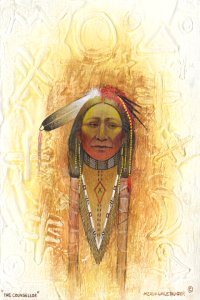
This strong sense of self-competition also drives his art production. His style ranges from poetic realism to expressionism to near abstraction. His subject matter is equally varied, covering everything from turn-of-the-century Cheyenne lifeways to Cheyenne families in the forties and fifties to wildlife paintings. His landscapes are known for their poetic execution, nuanced skies and brilliant colors, often rendered at miniature scale with a large dose of humor in their titles. His medicine paintings, which are executed on black board with bright primary colors, focus on spiritual themes and messages. A resident of Tulsa, Oklahoma for the past forty years, Merlin has remained actively engaged with the Cheyenne community and his Cheyenne ceremonies in west central Oklahoma. He consistently wins top awards at Santa Fe Indian Market and the Heard Museum Indian Market, and his paintings can be found in multiple museum collections: the National Museum of the American Indian in Washington, D.C.; Crystal Bridges, Arkansas; Gilcrease and Philbook museums in Tulsa; the Fred Jones Museum in Norman, Oklahoma; the National Museum of Cowboy and Western Art in Oklahoma City; and Maryhill Museum in Goldendale, Washington.